Understanding Gait
What Makes Them Special… Their Gait!
Saddle Rack
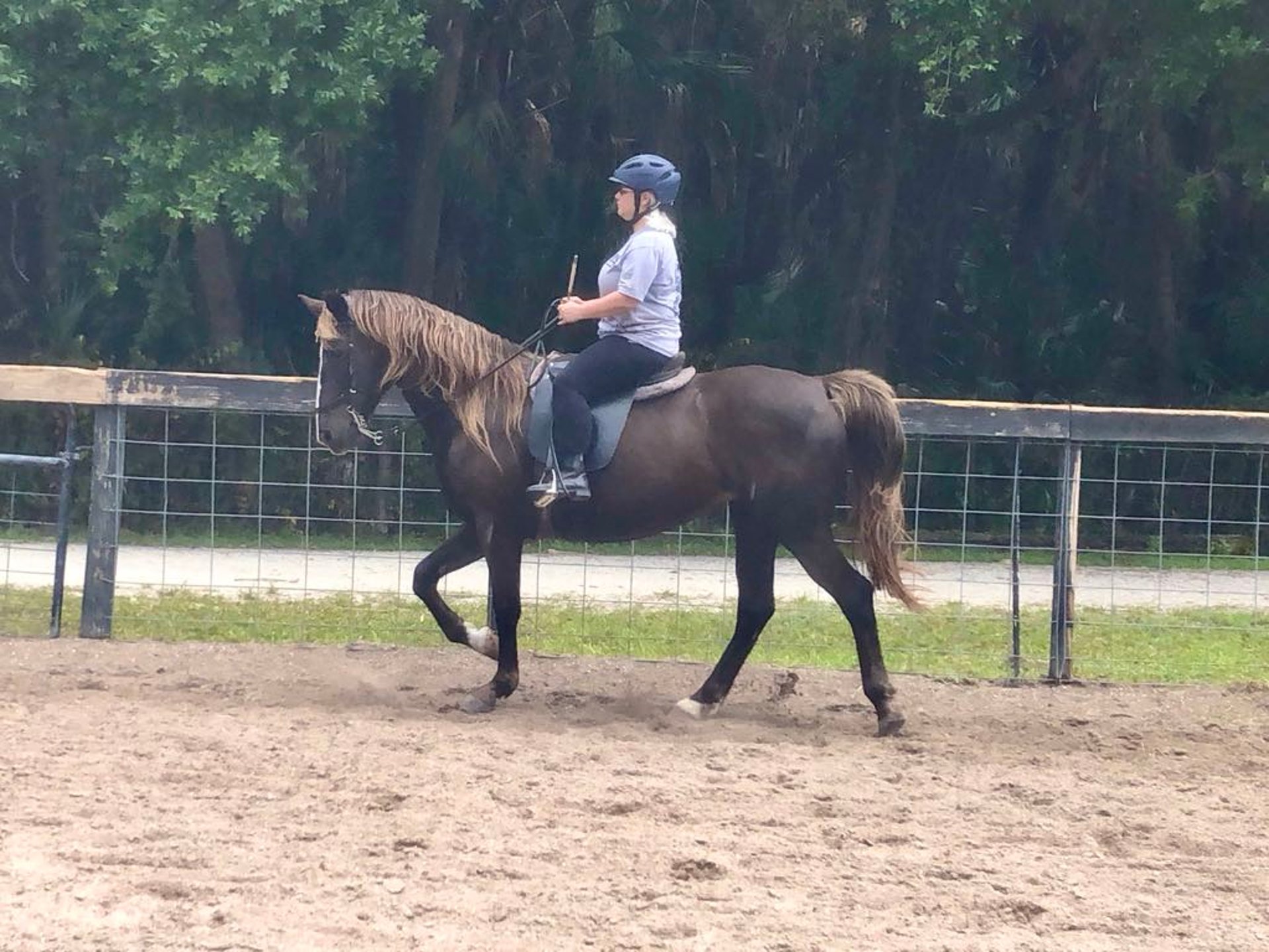
The Rocky Mountain Horse naturally demonstrates a smooth intermediate gait that glides forward, the saddle rack.
The saddle rack family of gaits is common among gaited horses around the world. Varying in speed and style, from the paso corto, to the slow tölt, to a singlefoot and more; the hallmark of the racking family of gaits is the lateral movement combined with independent footfall. This creates an evenly timed cadence that is quicker in tempo than the true “square gaits”, such as the flatwalk and running walk. A true saddle rack will not have a pause in the cadence. The back is slightly more hollow than neutral and the lateral pairs move together but set down independently creating that even cadence. The different racking gaits may vary stylistically in headset, reach from the hind, and lift of the front legs, but they will remain consistent in timing of footfalls and frame of the body.
The saddle rack is most commonly known for being a 3 foot, 2 foot support sequence. When speed is added, it becomes a 3 foot, 2 foot, 1 foot sequence and will be called a true rack, singlefoot or tölt. At speed, the horse will have a leaping step and at varying points in the sequence, only one foot will be on the ground supporting the horse. The lack of a suspension phase even at high speeds is what makes this gait very smooth.
On the trail, the Rocky Mountain Horse can move his feet with minimal ground clearance and reduced knee and hock action, because this gait does not waste motion, it enables the horse to travel long distance with minimal tiring.
The hind legs will have a scissor-like motion, whether reaching long or not, and the tail will bob up and down, particularly in the Rockies. The energy comes through the back end and engages in the shoulders and neck.
When ridden, this engagement of the coordinated muscles within the neck, shoulders, and back is specialized for the racking gaits. It is an energetic gait. The rider will feel the motion of the shoulders, but should not be jostled by it. There will be no gliding or upward motion, but a slight side-to-side seesaw of the hips. The horse will feel like they are pedaling a bike or climbing a ladder in the front. It is often described as being seated comfortably in the eye of a storm.
The Stepping Pace
The stepping pace, also known as the broken pace or amble, is likely the most common of the intermediate gaits in horses. It is a broken lateral gait, where the hooves on each side lift and set down in close succession, but not simultaneously, unlike in a true pace. The back is more hollow, the muscles more slack, and the tempo typically slower; however, some horses, particularly with very little lift in the front, will have a faster uneven cadence. The hind hoof always lands before the front hoof on the same side. This produces a distinct 1-2, 3-4 rhythm, often described with a “ka-chunk, ka-chunk, ka-chunk” sound, identical to that of the foxtrot.
The stepping pace is a three-foot, two-foot support gait, similar to the walk.
Like the saddle rack, the step pace seems to look universally similar despite breed or stylistic differences, but unlike the saddle rack, it can feel very different depending on the horse. Under saddle, it can be really smooth or it can be really rough. It depends on the horse's build, animation, and impulsion. The stepping pace may include a gentle side-to-side sway of the head, neck, and sometimes the body, though less exaggerated than in a true pace. The head and neck may have some up and down motion, the croup and tail remain steady, showing no vertical bobbing.
When ridden, the stepping pace usually involves rocking from side-to-side ride but with no jarring motion. Though generally comfortable, the lateral movement can occasionally induce a seasick sensation for some riders. A subtle increase in tension can sometimes be felt in the horse’s back muscles as each side alternates in motion.
The Pace
The pace is a two-beat, lateral gait where the horse moves both legs on the same side simultaneously; lifting, advancing, and setting them down together. While not typically classified as an easy gait due to its rough ride, it does appear in most gaited breeds and is purposefully ridden in some, such as Icelandic horses. The gait features a moment of suspension between each set of lateral footfalls and is most often performed at fast or racing speeds. Its rhythm produces a distinct 1-2 beat sound, often with noticeable overstride.
In pace, the horse shows no vertical motion in the head and neck, which instead swing side-to-side in rhythm with the forelegs. The hindquarters and barrel also sway laterally, and the whole body lifts and falls with each beat due to the suspension phase.
When ridden, the pace can feel abrupt and jarring, similar to a hard trot, but throwing the rider from side to side. While experienced riders can post to a hard pace, most who use the gait at high speeds sit it out. Though it may feel smoother at racing speeds, the pace is generally less comfortable than the intermediate gaits and is not ideal for long-distance riding.
The Transatlantic Rocky Mountain Horse Club
Promoting the Rocky Mountain Horse®
across Europe.
© 2025. All rights reserved.
Designed by clarity@2am